Aliens, Christian art, the soul, and implicit religion in Challenging Religious Issues

Aliens, Christian art, the soul, and implicit religion are just some of the topics discussed in the journal Challenging Religious Issues (Issue 16). The St Giles’ Centre has recently translated and published the Welsh version of this issue (the English version was published in Spring 2020).

A summary of the content of the articles is provided below. You can download both Welsh and English versions here.

Aliens: Ecclesiology and 1 Peter by Dr John Holdsworth

1981 saw the beginnings of a new direction in the study of 1 Peter, which hitherto had appeared to have reached an impasse. Sociological studies by Elliott and Goppelt have charted a new way forward that has helped to highlight the theology of 1 Peter, and particularly its ecclesiology, and which have helped redefine ecclesiological study. This has also provided new hermeneutical possibility.

The Nativity and Crucifixion in Christian Art: Encounter, Interpretation and Devotion by Dr Bridget Nichols

The article discusses the role of Christian art in forming Christian identity and devotional patterns, focusing on the birth of Christ and his crucifixion.

Mind, Brain and the Unifying Soul by Dr Mark Graves

The article presents an overview of the historical development of the concept of the soul in Western philosophy and theology, and in the context of current scientific perspectives.

Implicit Religion: A New Approach to the Study of Religion? by Dr Francis Stewart

The article argues that one change brought to the study of religion by the development and ultimate failure of the secularisation thesis was a new approach that sought to answer the question, ‘What is secular religion?’ This approach was Implicit Religion, whose origin, nature and significance are discussed here.

The Ineffable Mystery of God? by Professor Jeff Astley

The article explores the concepts of God’s ineffability, transcendence and mystery, with particular reference to religious experience and religious language.

Made in the Image of God: Experiences of a Woman with Disability in Nigeria by Jessie Fubara-Manuel and Elijah Obinna

This article discusses the Christian affirmation that humanity (with or without disabilities) is made in the image of God. For persons with disabilities (PWDs), this assertion is assuring and could provide basis for society’s collective journey towards equality, dignity and justice for all persons.

Agored Cymru Level 2 Award in Exploring Worldviews

Agored Cymru has a new Level 2 award, which focuses on exploring religious and non-religious worldviews. (The Level 1 award will be available shortly.)

This new suite of qualifications entitled Exploring Worldviews has been designed for 14- to 16-year-old learners, and aims to help develop skills, knowledge and experiences important for young people to live and work successfully in a diverse and rapidly changing society. Exploring Worldviews is able to support a flexible learning and teaching approach to statutory Religious Education (and Religion, Values and Ethics), when learners have not opted for GCSE Religious Studies. It is intended to be very different from the GCSE qualifications, which will not be affected by this development.

The Level 2 units now available include:

  • Understanding Worldview
  • Exploring my Worldview
  • Ultimate Questions
  • Medical Ethics
  • Ethics of Sport and Leisure
  • Worldviews in my Community

Along with colleagues from Wrexham and Swansea local authorities, the St Giles’ Centre initiated and was involved in creating this new suite of qualifications in order to help increase options available to Wrexham schools when delivering statutory Religious Education (and Religion, Values and Ethics).

Further information about this qualification is available here.

European news for Church and School

Those working in the field of Church and School may be interested to read the July 2021 newsletter from the Intereuropean Commission on Church and School (ICCS) and the International Association for Christian Education (IV).

Articles include the latest news from:

  • ICCS and IV;
  • Coordinating Group for Religion in Education in Europe (CoGREE) and its member organisations;
  • Conference of European Churches (CEC) and the Communion of Protestant Churches in Europe (CPCE).

Published on the ICCS* website, the newsletter can be accessed here.

* The Intereuropean Commission on Church and School (ICCS) is a network, created in 1958, which aims to provide a framework for cooperation in monitoring and developing church and school issues in Europe. It brings together representatives and experts from research, practice and policy working on religion and education.

Exploring Cynefin: the St Giles’ Centre offers professional learning opportunity

On 7 July 2021, a group of RE specialist teachers and leaders from Wrexham and Flintshire met to explore cynefin in the new curriculum for Wales. The aims of the session were:

• to support preparation for the new curriculum;
• to begin to uncover and deepen our knowledge and experience of cynefin;
• to encourage creativity and confidence in approaching cynefin in planning.

The Curriculum for Wales places great emphasis on cynefin, which is important within the Humanities Area and is identified as a disciplinary concept in RVE. The session provided an opportunity for participants to engage in research-based reflective practice to open up their thinking about cynefin, and they received resources and a certificate of participation from the St Giles’ Centre and its partner organisations, Wrexham County Borough Council and Bishop Grosseteste University.

The Centre looks forward to sharing more resources and professional learning with practitioners next academic year.

Consultation for Curriculum for Wales Religion, Values and Ethics (RVE) Guidance: Wrexham SACRE response

Thank you to all of you who shared with us views about the draft Curriculum for Wales Religion, Values and Ethics (RVE) Guidance Consultation. Your voice matters and the St Giles’ Centre is committed to sharing Wrexham experiences and opinions at local and national levels.

You may be interested to read the Wrexham SACRE response to the consultation here.

The deadline for submitting your own response to the consultation is 16 July 2021.

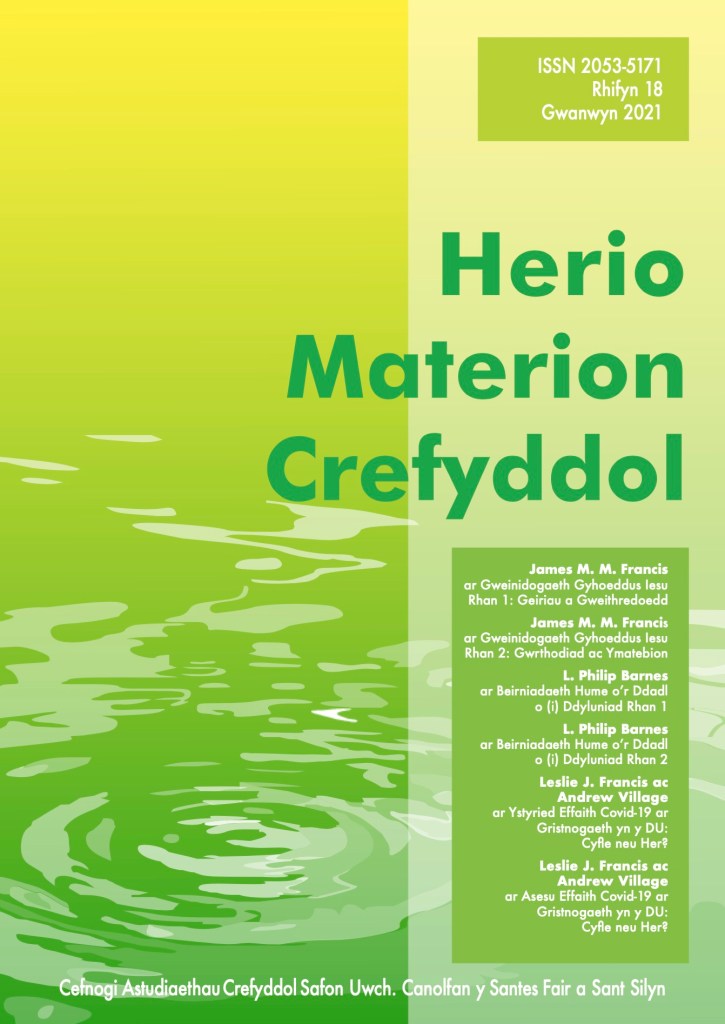
Welsh version of Challenging Religious Issues 18 now published

Issue 18 (Welsh version) of the journal Challenging Religious Issues (Herio Materion Crefyddol) supporting AS / A-level learners and teachers has recently been published.

Welsh articles include:

  • Jesus’ public ministry;
  • Hume’s criticism of the argument from (to) design;
  • the impact of Covid-19 on Christianity in the UK.

Visit our 16+ resources page to get free access to the latest journal issue (and all the back issues).

New issue of A-level Religious Studies journal now available: Challenging Religious Issues

Issue 18 of the open access A-level journal, Challenging Religious Issues is now available for download from the St Giles’ Centre website.

Articles discuss:

  • Jesus’ public ministry;
  • Hume’s criticism of the argument from (to) design;
  • the impact of Covid-19 on Christianity in the UK.

Established in 2013, Challenging Religious Issues is designed to support teachers and students engaged in A-level Religious Studies, bringing recent and relevant scholarship and research from the University into the A-level classroom. The journal is also of interest to anyone wanting to expand or deepen their subject knowledge more generally.

The Welsh-language edition of Challenging Religious Issues will be published online later this term.

Access the latest issue of the journal (and all the back issues) here.

Why RE (RVE) is relevant throughout our lives: new webinar for 14- to 16-year-old learners

Core RE webinar

The St Giles’ Centre is pleased to offer teachers and learners a new thought-provoking webinar designed to promote discussion and subject interest in statutory RE (RVE) lessons. The webinar has been created for the St Giles’ Centre by Dr Greg Barker and is part of a wider resource project to support RE (RVE) and Religious Studies at key stages 4 and 5.

This latest pre-recorded webinar resource shows how learning about religion, beliefs and values and a variety of ethical theories can be really valuable to learners throughout their lives, whatever path they follow. Therefore, RE lessons (which in the future will be called Religion, Values and Ethics lessons) are not only promoted as vital, but also interesting and worthwhile.

Watch a short 8-minute excerpt of this resource on our webinar page. Wrexham teachers can contact us for the link to the full-length video (28 minutes).

Welsh Government consultation on guidance for Religion, Values and Ethics now open

On Friday, 21 May 2021, the Welsh Government’s public consultation on the draft Religion, Values and Ethics (RVE) guidance opened. Everyone who has an interest in Religious Education (now renamed Religion, Values and Ethics) is being encouraged to engage with the consultation and to submit their responses.

The consultation forms an important part of the final stages of an extensive co-construction process intended to create additional support for schools, settings and SACREs with regard to Religion, Values and Ethics.

The St Giles’ Centre has put together a short 20-minute video which summarises what is in the Religion, Values and Ethic’s guidance and why it is there. You can access the video here. You can access the link to the consultation here.

If you are a practitioner working in Wrexham and would like to share your views directly with the St Giles’, please contact us and we will help your voice to be heard.

The deadline for consultation responses is: 16 July, 2021.

Celebrating the Welsh Bible translators: a special service for schools

St Asaph Translators Service for Schools

The Diocese of St Asaph has released a special bilingual service for schools to celebrate the 400th anniversary of the translation of the Bible into Welsh, an achievement that has had such a significant impact for society and culture in Wales.

The film makes many natural links with local place (cynefin). Seven of the eight translators came from the Diocese of St Asaph, and learners from local church schools offer key contributions to the film, alongside Bishop Gregory and the Very Revd Nigel Williams, among others.

Although structured as a ‘service’ (36 minutes in length), there are helpful section breaks that allow schools to incorporate specific aspects of the film into broader teaching and learning activities for RE (RVE) in the Humanities.

You can access the film here.

English (UK)